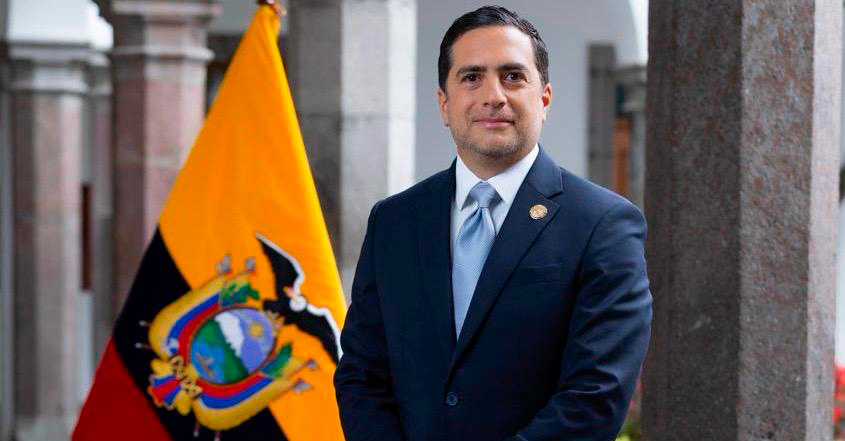
Interview with Roberto Kury Pesantes Ecuador’s Minister of Foreign Affairs and Human Mobility.
By
Karim Lesina
A former telecommunications executive and Minister of Telecommunications, Kury led Ecuador’s digital transformation before taking charge of the country’s foreign policy.
You recently assumed leadership of Ecuador’s foreign policy. What are the three international priorities you wish to define during your tenure?
Since assuming this responsibility, under the leadership of President Daniel Noboa, I have promoted active diplomacy because I am convinced that our international presence, within the framework and in compliance with foreign policy, must translate into results for Ecuadorians. In this regard, my administration has three clear priorities:
Security: Strengthening international cooperation to address, in a coordinated manner, the transnational threats affecting Ecuador, particularly organized crime, drug trafficking, arms trafficking, human trafficking, illegal mining, money laundering, and other forms of transnational crime. This entails deepening bilateral, regional, and multilateral cooperation in security, defense, intelligence, justice, and border control.
Trade and Investment: Using foreign policy as a tool for growth and the creation of opportunities for Ecuador, through market diversification, leveraging existing trade agreements, negotiating new agreements, opening new markets, and attracting foreign investment. We aim to ensure that our international relations translate into greater opportunities for productive sectors and generate employment and development for the country.
Multilateral Positioning. Strengthening Ecuador’s presence and influence in international organizations and forums, actively positioning our national interests and contributing to discussions and agreements on peace and security, human rights, and sustainable development.
In short, our foreign policy will have three clear priorities: security to protect Ecuador and its people, trade and investment to generate opportunities and employment, and multilateral engagement to defend and project our national interests globally.
Ecuador currently faces significant security challenges and substantial economic opportunities. How do you want foreign policy to contribute more directly to security, investment, and economic growth?
Foreign policy must be a concrete tool at the service of national priorities. Regarding security, we want to deepen cooperation with our partners to jointly combat transnational organized crime, strengthen our institutional capacities, and promote greater regional and global coordination. Security is also an essential condition for building trust, attracting investment, and guaranteeing development opportunities for Ecuadorians.
In the economic sphere, our diplomacy must open doors for Ecuador: expanding markets, attracting productive investment, facilitating trade, and promoting alliances that generate employment, innovation, and growth. We want to project the country as a reliable, stable, and open partner to the world, capable of transforming its international relations into concrete results for its citizens. Security and economic development are not separate agendas: a safer Ecuador is also a more competitive Ecuador with greater opportunities for prosperity.
We are moving in that direction. In security, we have strengthened coordination with partners and international organizations to confront transnational organized crime. On the economic front, we have secured new agreements with strategic partners such as the United States, the European Union, and Canada. This is complemented by progress with the United Arab Emirates and South Korea, as well as concrete advances in improving market access for our products in countries such as Japan, Morocco, India, Panama, and the Dominican Republic. These are examples of a foreign policy geared toward producing concrete results in security, investment, trade, and opportunities for Ecuador.
Ecuador has significantly strengthened its relationship with the United States. What would a long-term strategic alliance between Ecuador and the United States look like, beyond the immediate security agenda?
The government of President Daniel Noboa has launched a frontal assault against transnational organized crime and drug trafficking, for which it has the firm support of the United States. President Noboa is convinced that only by consolidating security and stability will it be possible to achieve sustainable prosperity for Ecuadorians and, at the same time, strengthen the confidence of international partners in the country. This prosperity translates into greater employment opportunities, access to education, and improved living conditions for the population.
In this context, Ecuador has been building a strategic alliance with the United States, reflected in the signing of the Framework for Assuring Supply in the Mining and Processing of Critical Minerals and Rare Earth Elements (February 2026), the Reciprocal Trade Agreement (March 2026), and the Memorandum of Understanding on Cooperation in Nuclear Energy (April 2026), an instrument that constitutes a preliminary step toward negotiating a Cooperation Agreement on Nuclear Energy for Civil Use (Agreement 123).
Furthermore, Ecuador was declared eligible for the Millennium Challenge Corporation (MCC), a status that can translate into large-scale non-reimbursable grants, generally between USD 300 and 500 million, intended to finance projects that eliminate constraints on economic growth.
Ecuador is simultaneously advancing in strengthening its macroeconomic indicators and internal capacities, as well as in consolidating the trust of its strategic partners, with the aim of creating favorable conditions to attract investment, boost economic growth, and create real development opportunities for its population.
Organized crime, drug trafficking, illegal mining, and money laundering are increasingly operating across borders. Does Latin America need a much stronger regional security architecture? What role could Ecuador play in building it?
Transnational Organized Crime is a phenomenon that transcends national borders, threatens democratic stability, and seeks to undermine peace and security through violence and corruption. We have prioritized international cooperation and coordination in various areas, such as border control, financial and tax intelligence, migration control, and information sharing, among others.
Ecuador has been working effectively and coherently on building a regional and subregional security architecture, among other things, through its participation in the following mechanisms:
● Andean Community (PAR – GAN)
● Shield of the Americas
● Santiago Regional Commitment against Transnational Organized Crime
Within the framework of the Andean Community, Ecuador, along with the other countries of the subregion, adopted Decision 922, a historic milestone that gave rise to the High-Level Group (GAN Spanish acronym) as a political and operational body. This group established the Resolutive Action Plan (PAR in Spanish acronym), aimed at comprehensively combating various criminal phenomena affecting our countries, including illegal mining, arms trafficking, money laundering, human trafficking, and drug trafficking, among others. This plan is structured around 4 pillars, 13 measures, and 96 concrete actions to combat transnational organized crime.
Furthermore, Ecuador participates in the Santiago Regional Commitment against Transnational Organized Crime, which issued a Political Declaration on May 28, 2016, seeking to strengthen regional coordination and cooperation to jointly combat transnational organized crime. The following countries are part of the Santiago Regional Commitment: Argentina, Bolivia, Chile, Ecuador, Paraguay, Peru, and Uruguay.
Ecuador participates in the “Shield of the Americas” initiative, promoted by the United States, which seeks to strengthen hemispheric cooperation against transnational organized crime, particularly drug trafficking, drug cartels, and other illicit economies that affect the security of the countries of the Americas. Member countries are: Argentina, Bolivia, Chile, Colombia, Costa Rica, the Dominican Republic, Ecuador, El Salvador, Guyana, Honduras, Panama, Paraguay, Peru, Trinidad and Tobago, and the United States. On September 22, 2016, within the framework of the UN General Assembly, a Summit of Heads of State of the Initiative was held at its headquarters in New York, in which the President of the Republic represented Ecuador. At the meeting, a Joint Declaration was adopted that includes sanctions against organized crime groups, including asset freezes, immigration restrictions, and criminal liability for those who provide them with support. Also included was a list of 25 criminal organizations that the United States proposes to designate as Foreign Terrorist Organizations and Specially Designated Global Terrorists. Ecuador is moving forward with the analysis for its potential designation and, as a key partner in this initiative, seeks to strengthen cooperation in the areas of security, economics, and multilateralism.
More generally, what should Ecuador’s relationship with Latin America be like? Do you see an opportunity for a more pragmatic regional agenda focused on trade, investment, infrastructure, and security, rather than political divisions?
The logic of a pragmatic foreign policy makes it possible to reconcile the defense of the principles of international law with the need to interact in a sovereign manner, based on shared interests with other countries in the region, with an emphasis on building agreements and strategic alliances that promote Ecuador’s economic and social development.
Ecuador is a country convinced of the benefits of Latin American integration, and we will therefore continue to deepen intraregional trade and broaden its scope, ensuring that economic integration is not limited to the exchange of goods, but fully incorporates trade in services and new opportunities for productive integration. To this end, it is essential to continue strengthening production chains, facilitate the movement of goods and services, and create better conditions for the participation of SMEs, which constitute a fundamental part of our business fabric.
We have supported Latin American efforts aimed at strengthening physical integration and regional connectivity, recognizing the role of infrastructure as a fundamental element for facilitating trade, promoting the integration of production chains, and reducing gaps between the countries of the region, through the development of studies, information systems, and facilitation mechanisms within the framework of ALADI (Latin American Integration Association).
Europe
Europe is already an important trade and investment partner for Ecuador. With the new EU-Ecuador Sustainable Investment Facilitation Agreement, which sectors could drive the next phase of European investment in the country?
Once the Agreement is signed and enters into force, Ecuador will be able to promote European investment in strategic sectors for its productive transformation, such as digitalization, agriculture, transport, logistics, manufacturing, and sustainable raw materials, with a special emphasis on renewable energy and the energy transition. Ecuador has significant untapped potential in this area, which aligns directly with European priorities for decarbonization, energy security, and sustainable infrastructure, as well as with the Global Gateway strategy.
The Agreement aims to simplify procedures, increase transparency and predictability for investors, and facilitate sustainable investments in the country’s key sectors of interest, with the potential to generate employment, technology transfer, and new productive capacities.
Ecuador has also achieved a regional milestone by being the first and, so far, only country in Latin America to have concluded negotiations on a Sustainable Investment Facilitation Agreement (SIFA) with the European Union. The negotiations concluded on January 23, 2026, and on September 11, the European Commission submitted the proposal to the Council for signature and conclusion. The Agreement will subsequently require the consent of the European Parliament to complete the European process prior to its entry into force.
Beyond trade, in what areas would you like to deepen the strategic relationship with Europe: security, technology, energy, critical infrastructure, education, or digital cooperation?
The relationship between Ecuador and Europe is becoming increasingly comprehensive. Trade and investment are fundamental pillars.
A primary focus is undoubtedly security. Organized crime is transnational, and the responses must be transnational as well. Today, Ecuador and the European Union cooperate in the fight against drug trafficking, money laundering, transnational organized crime, port and airport security, border management, and information sharing. Programs such as EUFORT-EC, SERPAZ, COLIBRI, EL PAcCTO 2.0, EUROFRONT, and SEACOP V demonstrate that a significant platform already exists on which to deepen this relationship.
The Cooperation Agreement with Europol, in force since April 8, 2026, also represents a qualitative leap forward because it strengthens information sharing and cooperation against transnational organized crime. For Ecuador, this confirms that Europe is not only an economic partner, but also a strategic partner in security matters.
A second area is technology and digital cooperation. We are interested in advancing cybersecurity, data protection, systems interoperability, secure information exchange, and the application of new technologies to public administration and security. Ecuador has already made progress in this direction with migration management systems that incorporate biometrics, e-Gates, and verification mechanisms using national and international databases.
We also see significant room for strengthening the security and resilience of strategic infrastructure, particularly ports, airports, borders, and logistics chains. The goal is not only to protect Ecuador: strengthening our capabilities against organized crime also contributes to confronting transnational threats that have direct effects on Europe.
Finally, we are interested in this cooperation generating long-term capabilities: technology transfer, specialized training, institutional strengthening, and knowledge exchange. The relationship between Ecuador and Europe must evolve into a true strategic partnership, based not only on economic interests, but also on security, innovation, resilience, and mutual trust.
Visa exemption for travel to the Schengen Area remains an important objective for Ecuador. What priority does it have for your government, and what is needed to advance this process?
It is a priority of Ecuador’s foreign policy in our relationship with the European Union and its member states. It is not only about facilitating the mobility of our citizens; it is also a matter of reciprocity, integration, and equity within a relationship that has deepened considerably in recent years.
Ecuador has made concrete progress in the main areas considered by European visa policy. We have biometric passports compliant with ICAO standards; we participate in its Public Key Directory; we grant visa-free entry to nationals of all European Union member states; we have modernized our migration management system through biometrics, e-Gates, and verification mechanisms using national and international databases; we have readmission mechanisms and do not apply citizenship-by-investment schemes.
In addition, there is a particularly significant development: our Cooperation Agreement with Europol, which strengthens information sharing and cooperation against transnational organized crime, has been in force since April 8, 2026. This demonstrates the level of trust achieved between Ecuador and the European Union in a particularly sensitive area.
There is also an element of regional coherence that cannot be ignored: Ecuador is the only one of the thirteen Pacific coastal countries in the Americas whose citizens still do not have Schengen visa exemption.
Therefore, we believe an objective and up-to-date evaluation of Ecuador’s situation is warranted. We are not asking for European standards to be lowered; we are demonstrating that the country has strengthened its capacity to meet them.
We know that the process requires a proposal from the European Commission and subsequently the participation of the European Parliament and the Council. That is why we are working simultaneously with European institutions, Member States, and the European Parliament, including through parliamentary diplomacy. Our goal is to keep this issue at the highest level of political dialogue with the European Union and move towards a decision based on the current reality of Ecuador.
Ecuador is also deepening its relations with partners such as the United Arab Emirates and Japan, while maintaining significant economic ties with China. How is Ecuador positioning itself in an increasingly competitive geopolitical environment without being forced to choose between the major powers?
We have opted for a pragmatic, open, and results-oriented foreign policy that seeks to expand opportunities, diversify our partners, and preserve our decision-making capacity. National interests and the capacity of each relationship to contribute to the development, security, and well-being of Ecuadorians guide our actions.
Trade and investment are good examples of this vision. With the United Arab Emirates, we signed the Comprehensive Economic Partnership Agreement (CEPA) on March 1, 2026, which opens new prospects for trade and investment. With China, we continue to leverage the opportunities offered by the Free Trade Agreement in effect since May 2024, with significant results: between January and July 2026, Ecuadorian non-oil exports to that market reached USD 4.374 billion, a 29% increase compared to the same period in 2025. In addition, with Japan, we are building a deeper economic relationship: the Second Meeting of the Ecuador-Japan Economic and Trade Committee, held in Quito on September 30, allowed us to move forward toward a potential Economic Partnership Agreement.
At the same time, we are working to ensure that these relationships extend beyond trade. With the United Arab Emirates, for example, there is a growing agenda focused on security, technology, and investment. For Ecuador, it is a priority to strengthen its capabilities in combating drug trafficking, illegal mining, and organized crime by incorporating more technology and intelligence. Likewise, the interest of Emirati companies in strategic sectors demonstrates the potential for attracting capital, technology, and new production capabilities.
In short, Ecuador is not seeking exclusive alliances. We seek partners. We want to keep open all doors that generate opportunities for the country, diversify our markets, attract investment, and strengthen our security. In an increasingly competitive international landscape, our best position is to engage in sovereign and constructive relationships, always placing Ecuador and its interests at the heart of our decisions.
You come to the Ministry of Foreign Affairs after leading Ecuador’s telecommunications and digital agenda. Do you believe that technology, AI, and digital transformation will become instruments of Ecuadorian foreign policy, both to attract investment and to build new international alliances?
Yes. For Ecuador, technology, artificial intelligence, and digital transformation must be projected as instruments of foreign policy and economic competitiveness, capable of attracting investment, technology, and knowledge. The country is making progress in building a comprehensive digital agenda and has taken a fundamental step: the publication of the Strategy for the Promotion of the Development and Ethical and Responsible Use of Artificial Intelligence in Ecuador, which establishes the 2025-2029 roadmap and articulates AI governance around principles such as transparency, human oversight, protection of rights, security and inclusion.
AI is also seen as an enabler of growth in strategic sectors such as energy, logistics, port infrastructure, and connectivity.
From a foreign policy perspective, the goal is to transform these advances into a platform for attracting technological investments and building international alliances with governments, multilateral organizations, and companies that contribute digital infrastructure, innovation, training, and technology transfer.
Ecuador has a framework based on the Organic Law for Digital and Audiovisual Transformation and the Organic Law for the Protection of Personal Data. Since May 2016, Ecuador has been the third country in Latin America and the Caribbean to have a cybersecurity framework law approved by its legislature.
Looking ahead five years, what position would you like Ecuador to hold internationally, both in the Americas and globally?
Today, we must create the conditions for a better future. Therefore, we are working now to generate the conditions that the Ecuador of the future requires, strengthening cooperation with the international community on security matters through bilateral, regional, and hemispheric alliances that will allow us to improve our capacity to combat transnational organized crime and its related offenses.
We are working to make Ecuador an increasingly attractive country for foreign investment, developing a legal framework to facilitate such investments in our country and boost trade. This also requires consolidating energy generation capacity, so we are also focused on addressing this issue to ensure that future energy demand can be met.
In five years, Ecuador will be a safe, educated, and entrepreneurial society that produces and prospers alongside the country. It will have a stable economy supported by improved security and strong, ethical, and capable institutions. We aspire for the Ecuador of the future to have investments in key sectors of our economy such as energy, agriculture, logistics, infrastructure, and telecommunications, along with the constant growth of our exports and the diversification of our markets.
We aspire for Ecuador, within five years, to become a benchmark in the Americas and worldwide for how a nation can prosper by overcoming adversities such as the scourge of transnational organized crime.